
The Janon Plate Cracker
ADDENDUM to “Macadamias: An Overview and Guide to Preservation Principles and Engineering Practice” – Page 448 (b) – Chapter 6. New Clause 6.8.9 ix.
The Janon Plate Cracker is the latest cracker invention only entering the market in 2022 after the publication of the 2nd Edition of this book and uses patented technology to crack the nuts between two Stainless Steel plates. This type of cracker is yielding higher whole kernel recoveries, larger pieces and therefore style improvement, while minimising kernel bruising, fine kernel and shell dust and reduced shell impregnation into kernel.
This cracker does not require nuts of the same cultivar or shell thickness to be processed together and all mixes of cultivars can be cracked simultaneously in the same batch. This has the benefit of allowing Processors to store nuts in mixed conditions increasing their storage efficiency. The Janon cracker has a capacity of 750 kg/hr DNIS.
Dried NIS is pre-sized by diameter into size ranges of about 2mm and then processed through the cracker by size. In the cracker the lower plate remains stationary, while the upper plate moves up and down in a patented action, so that the same displacement of every part of the upper plate is maintained. The two plates are inclined, so that nuts and cracked product can proceed through under gravity and tapers in the upper plate are introduced from the inlet, narrowing towards the outlet, so that nuts of irregular shape or varying diameters in the size range, will all find exactly the correct amount of squeezing pressure, that will shatter the shell, without placing pressure on the kernel.
Nuts will receive multiple squeezes as they pass through the cracker and will continue to be subjected to larger squeezes/deflections as they enter narrower and narrower spaces, until the applied deflection is just adequate to cause the shell to rupture, releasing the kernel. This process limits high velocity component to kernel interactions and overstrike, effectively minimising unwanted damage to kernel.
Shell wall thickness does not affect the result of the cracking, because thicker walled shells will require less deflection for rupture, so they will tend to crack in the larger portions of the plate gaps, while thinner shelled nuts of the same diameter require more deflection to rupture the shells and so they will crack lower down, where the deflections are greater. Once the shell ruptures and bursts open, the kernel is released and this is of a smaller diameter than the plate gaps, so the kernel rolls out without being subject to any more impacts or damage.
Changing from one size range to the next can be achieved without switching off the cracker simply by adjusting the handwheels and can take less than a minute. Processors that require various size ranges to be processed simultaneously, because of a batch requirement, would need to have several crackers in tandem, each cracking a particular size, while those without that restraint could use all the crackers on one size at a time. The Janon Crackers will then require sizing decks and temporary storage bins just before cracking.
Sizing DNIS accurately is important, because wide variations of sizes in a batch will affect whole kernel recovery and Style loss. It has been found that the spiral roller sizers will provide the best sizing process, because it works on finding the minimum diameter of each nut. The Janon Cracker can however be configured to handle larger nut size ranges than 2mm, but this will result in a loss of Style recovery. Because of the arrangement of tapers in the cracker, it is necessary to ensure that between 5% and 8% of PNC’s (partial or no cracks) are produced to balance between overcracking and unwanted damage to kernel and unnecessary return product.
Other measured benefits are that the shell pieces are considerably larger than with other crackers and there are much less fine shell fragments and shell dust. This simplifies separation and reduces the risk of shell dust impregnation into kernel. Kernel bruising and Styling losses are much reduced due to limited contact between cracker plates and the kernel.
Recent testing of 38 different batches of separate cultivars and mixed Integs, yielded combined average results of 64.1% Whole kernel, 33.3% Halves, only 4.5% Pieces. This shows that the whole spectrum of styles has been increased, increasing the value of the recoveries considerably. In fact more than 95% of the recoveries were in the Wholes and Halves classes. The average PNC’s was 5.8%, well within the optimum range. See figure 6.7 c for the graph of the total average crackout on these 41 samples.
It must be emphasised that proper curing and drying of the kernel is imperative to minimise adherence of kernel to the shell and poor kernel and style recoveries. The plate cracker can however be used with equal efficiency on kernel with moisture contents in the ranges of 1.5% to 3%.
The 38 samples tested were sourced from 3 different growing regions in South Africa and from different harvesting times, so they represent fairly well the full spectrum of NIS product. Some of the nuts were thick shelled varieties such as Beaumont 695 and even these showed excellent style recoveries. Nuts towards the end of the season are frequently not fully matured and have been coaxed from the tree by beating or application of ripening chemicals, so the shells are also not as well developed or brittle and can display a more fibrous nature. This leads to incomplete bursting of the shells and reduced TKR, but the results with this plate cracker are still higher than with other cracker types.
In 16 of the tested samples, each size range in the batch was tested separately and the results show that recovery of whole kernel from 18mm upwards is very consistent. Many shellers have extremely poor crackouts on nuts smaller than 20mm. See Fig 6.7 d. Up until now, it has been normal for the recovery of wholes to be much lower on the smaller sizes, often because they are less mature and have been affected in their development by insects or weather induced stresses.
The Janon plate cracker has a footprint of approximately 1m x 1m, requires 3-phase power for it’s 3kW motor and has very low maintenance requirements.
The Janon Cracker is approaching the ideal cracker as postulated in section 6.8.9 “Note to inventors: The ideal cracking machine will have a utopian ability. It must crack all dehydrated cultivar types and sizes regardless of shell thickness, rapidly, and release only whole kernels from their shells without damaging them in any way.”
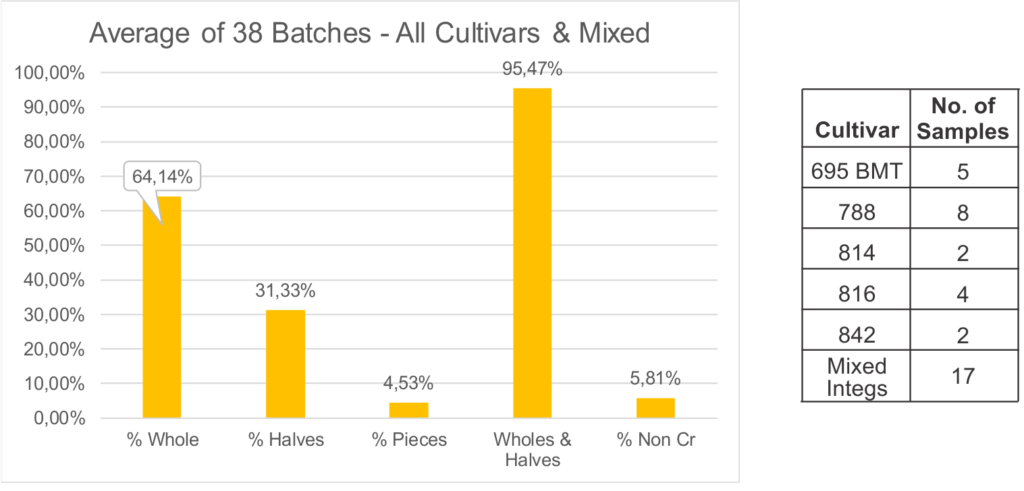
6.7 c: Average Crackout Across All Samples
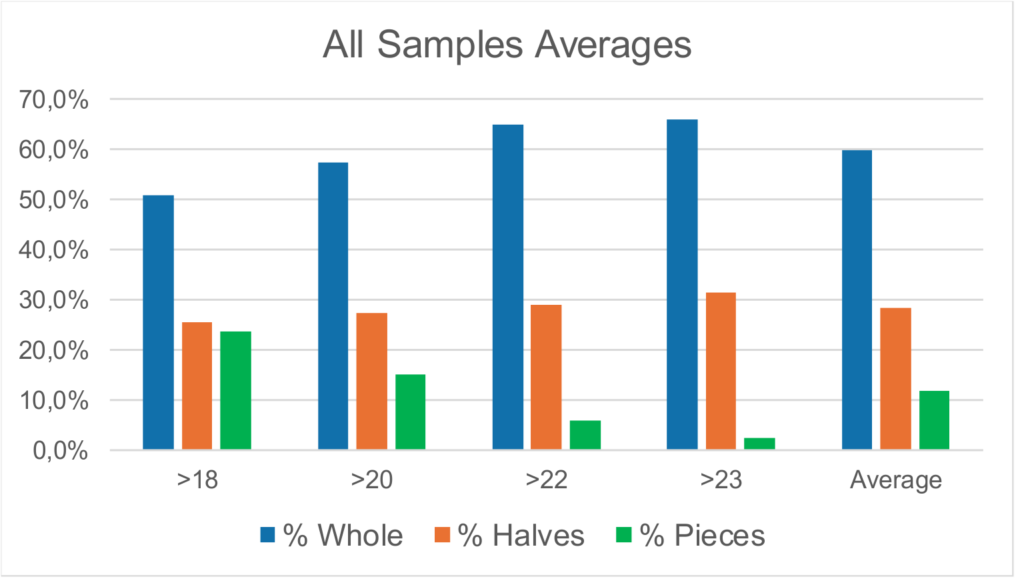
6.7 d: Crackouts from all samples in the size ranges
Contact: Geoff Harwood
geoff@janoncracker.com
+27 82 805 3058
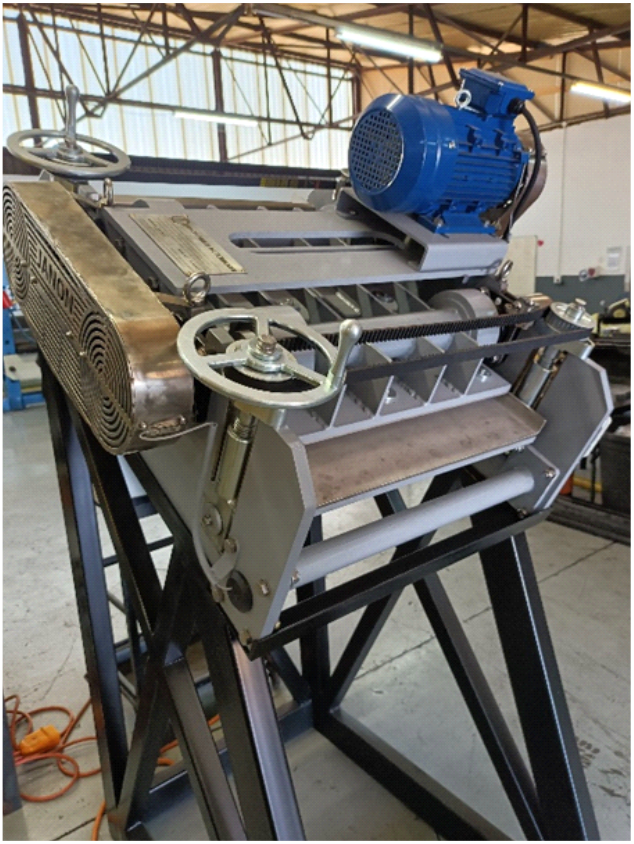
Basic Janon Cracker
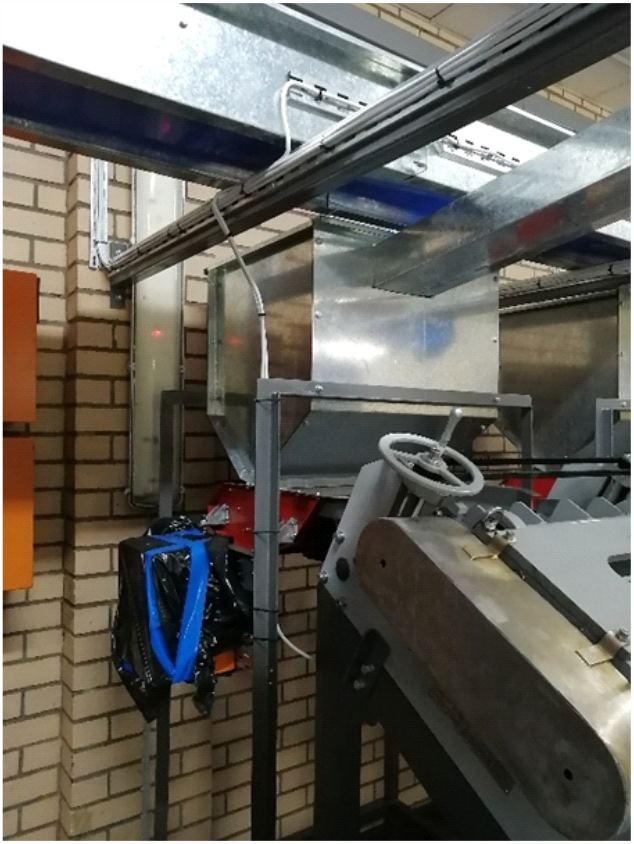
Cracker with hopper/feeder
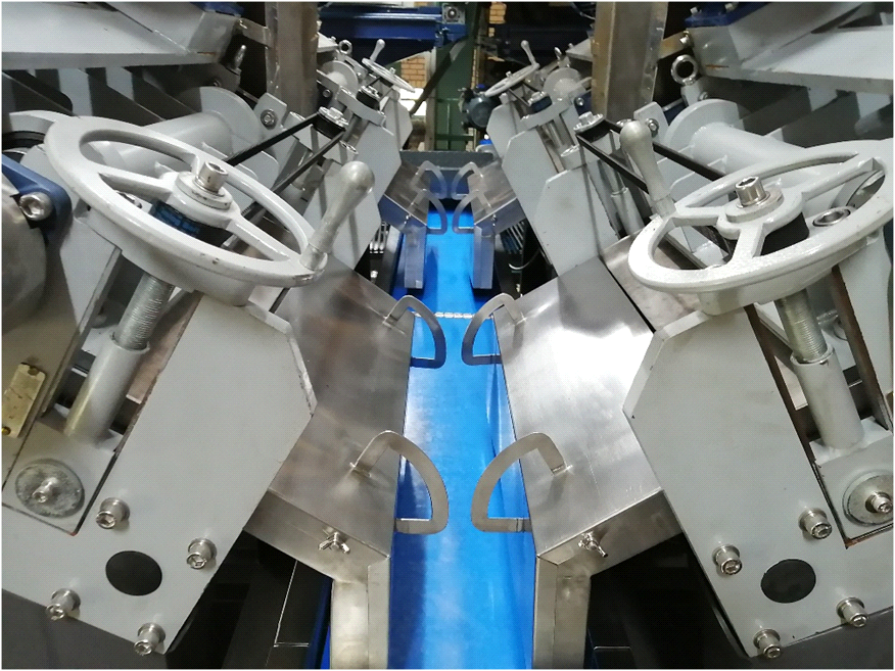
4 Cracker in one pod around discharge conveyor